Coming Soon From Robert Conti. . .
OPEN YOUR EYES, IT'S ALL HERE!
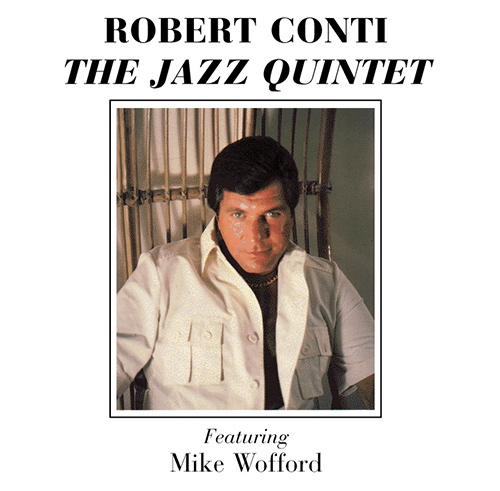
In March, 1981, one week after appearing as a guest artist on Gerald Wilson's Orchestra Of The Eighties, Robert Conti returned to the same Los Angeles studio, to record "The Jazz Quintet" for the L.A. based Discovery Records Label. The featured track of the masterclass is "Rotation" an original tune recast over the chord progression to Cherokee.
After receiving a shipload of requests for a masterclass on the main theme and Robert's blistering sixty four measure solo, Robert painstakingly transcribed the intro, 64 measure head and 64 measure solo. Consistent with all his prior learning resources, he will teach you to play every measure, on video phrase-by-phrase, note-by-note.
Learning complex improv vocabulary cannot be made any easier. NOTE: The main theme of Rotation may be utilized as an actual solo over the progression of Cherokee!
The Conti "Forward Motion" Teaching Platform Is Focused First On Playing Only. After you acquire a certain amount of applicable improv vocabulary, Robert explains the "Nuts & Bolts" harmonic devices that you hear him utilize on this recording.
The tempo on Rotation is at a mind boggling 296bpm for advanced players. However, for players at an earlier skill level, Robert has a unique way of teaching you how to "mine the lines" and essentially adjust complex lines to your current comfort level of technical ability. If you're seeking high impact learning, discover what six well documented decades of teaching and performance experience can place under your fingers! The musicians crossed the finish line of this musical marathon with smiles about their accomplishments - yet exhausted!
But I heard it's not really improvising if I learn someone's solo!
Nonsense. Jazz IS a language. To excel at any language, you must practice the language and learn the vocabulary. You can read all about nouns, participles, verbs and still be a terrible public speaker. Mode merchants will say otherwise, but just ask to hear them play with a burnin' rhythm section like the video above. Then watch them run for the hills or give you excuses why they can't. There's no substitute for skill.
Internet marketers masquerading as jazz guitarists can only hide behind words and sales pitches for so long. At some point, they have to play - and that's when you separate the men from the boys.
Enjoy Short Samples From Each Song On The Album:
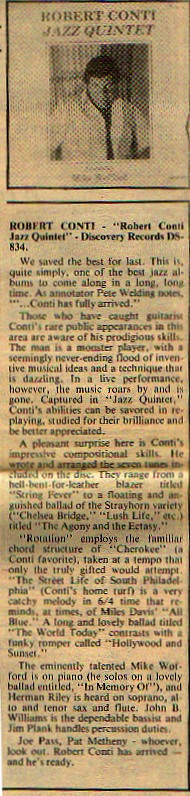
Southeast Entertainer Review by Pete Mandell, 1982
We saved the best for last. This is, quite simply, one of the best jazz albums to come along in a long, long time. As annotator Pete Welding notes, "...Conti has fully arrived."
Those who have caught guitarist Conti's rare public appearances in this area are aware of his prodigious skills. The man is a monster player, with a seemingly never-ending flood of inventive musical ideas and a technique that is dazzling. In a live performance, however, the music roars by and is gone. Captured in "The Jazz Quintet," Conti's abilities can be savored in replaying, studied for their brilliance and be better appreciated.
A pleasant surprise here is Conti's impressive compositional skills. He wrote and arranged the seven tunes included on the disc. They range from a hell-bent-for- leather blazer titled "String Fever" to a floating and anguished ballad of the Strayhorn variety ("Chelsea Bridge," "Lush Life," etc.) titled "The Agony Of Ecstasy."
"Rotation" employs the familiar chord structure of "Cherokee" (a Conti favorite), taken at a tempo that only the gifted would attempt. "The Street Life Of South Philadelphia" (Conti's home turf) is a very catch melody in 6/4 time that reminds, at times, of Miles Davis' "All Blue." A long and lovely ballad titled "The World Today" contrasts with a funky romper called "Hollywood and Sunset." The eminently talented Mike Wofford is on piano (he solos on a lovely ballad entitled, "In Memory Of"), and Herman Riley is heard on soprano, alto and tenor sax and flute. John B. Williams is the dependable bassist and Jim Plank handles percussion duties.
Joe Pass, Pat Metheny - whoever, look out. Robert Conti has arrived -- and he's ready.
Jazz Improv Magazine Review by Ethan Gutzeit, 2004
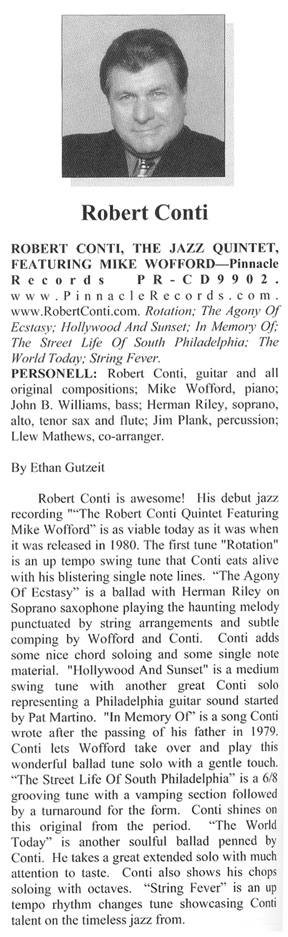
Robert Conti is awesome! His debut jazz recording "The Robert Conti Quintet Featuring Mike Wofford" is as viable today as it was when it was released in 1980. The first tune "Rotation" is an up tempo swing tune that Conti eats alive with his blistering single note lines. "The Agony Of Ecstasy" is a ballad with Herman Riley on Soprano saxophone playing the haunting melody punctuated by string arrangements and subtle comping by Wofford and Conti. Conti adds some nice chord soloing and some single note material. "Hollywood and Sunset" is a medium swing tune with another great Conti solo representing a Philadelphia guitar sound started by Pat Martino. "In Memory Of" is a song Conti wrote after the passing of his father in 1979. Conti lets Wofford take over and play this wonderful ballad tune solo with a gentle touch. "The Street Life Of South Philadelphia" is a 6/8 grooving tune with a vamping section followed by a turnaround for the form. Conti shines on this original from the period. "The World Today" is another soulful ballad penned by Conti. He takes a great extended solo with much attention to taste. Conti also shows his chops soloing with octaves. "String Fever" is an up tempo rhythm changes tune showcasing Conti talent on the timeless jazz form.
BOB CONTI, Rediscovered Genius,
by Pete Welding - Guitar World Magazine, 1982
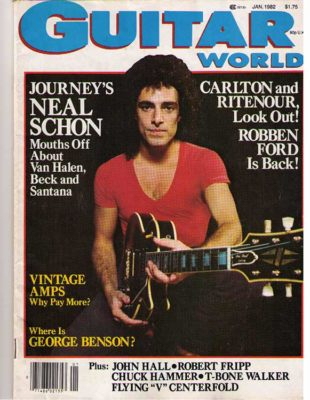
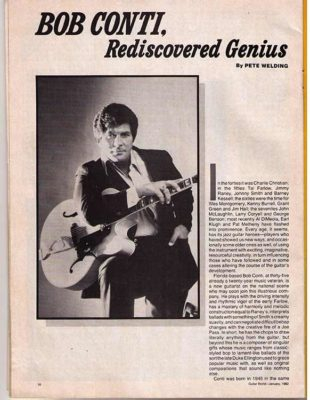
In the forties it was Charlie Christian; in the fifties Tal Farlow, Jimmy Raney, Johnny Smith and Barney Kessell ; the sixties were the time for Wes Montgomery, Kenny Burrell, Grant Green and Jim Hall; the seventies John Mclaughlin, Larry Coryell and George Benson; most recently AI DiMeola, Earl Klugh and Pat Metheny have flashed into prominence. Every age, it seems, has its jazz guitar heroes-players who have shown us new ways, and occasionally some older ones as well, of using the instrument with exciting, imaginative, resourceful creativity, in turn influencing those who have followed and in some cases altering the course of the guitar’s development.
Florida-based Bob Conti, at thirty-five already a twenty-year music veteran, is a new guitarist on the national scene who may soon join this illustrious company. He plays with the driving intensity and rhythmic vigor of the early Farlow, has a mastery of harmony and melodic construction equal to Raney’s, interprets ballads with something of Smith’s creamy suavity, and can negotiate difficult bebop changes with the creative fire of Joe Pass. In short, he has the chops to draw literally anything from the guitar, but beyond this he is a composer of singular gifts whose music ranges from classic styled bop to lament-like ballads of the sort the late Duke Ellington used to grace popular music with, as well as original compositions that sound like nothing else. Conti was born in 1945 in the same section of South Philadelphia that over the years has produced a number of gifted players of stringed instruments, from Joe Venuti and Eddie Lang up to Pat Martino.
Conti had taken up the instrument at age twelve, and studied privately with Joe Sgro, a highly regarded local guitarist and teacher. Beyond this brief early instruction, however, Conti is completely self taught. He turned professional at fourteen, and for the next two years worked with a number of commercial rock and roll groups in the Philadelphia area. At an age when most of his peers were dealing with acne, dating and other problems of adolescence, he was fully involved with music as a profession, often earning hundreds of dollars. At sixteen, he left home and spent the next half-dozen years touring the country with shows and revues, playing all sorts of jobs. It was a grueling, demanding apprenticeship but he learned a great deal from it.
In 1966, having tired of road life, he settled in Neptune Beach, near Jacksonville, Fla., where he has lived since. “In some respects it was the worst thing I could have done,” he notes wryly. “While it’s a wonderful place to live and raise a family [he and his wife have two children], it’s absolutely dead musically. There’s no-repeat no-musical scene here at all. Jazz acts on tour pass right by the place.” For the next five years, Conti supported himself by teaching, which he enjoyed, but from 1971 to early ’76 he gave up all musical activity and involved himself in the securities and commodities exchanges, at which he was quite successful. “It almost killed me, though,” he observed. “The pressure was unbelievable, and finally I just had to return to music. But for those six years I never once touched the guitar.” Since then he’s returned to teaching, played whatever engagements have come his way. During the last year he was featured in three concerts with the Jacksonville Symphony Orchestra.
More important still are the recordings Conti has been making over the last year or so for the Los Angeles jazz label Trend/Discovery Records through which word of this remarkable player has been carried far beyond the precincts of Neptune Beach. Latin Love Affair, a frankly commercial album of Disco flavored Latin music, was succeeded by the much more impressive Solo Guitar, a beautifully realized program of lovely unaccompanied ballad performances, notable for Conti‘s unerring technical command and enriching harmonic savvy. Easy listening music in the very best sense of the term. Scattered through both sets were intimations of his striking abilities as a jazz guitarist-a brilliantly played passage here, a dazzling arpeggio there – but it remained for his third album to show just how truly formidable and original a player Conti is.
This recording, Robert Conti and The Jazz Quintet, on Discovery Records, is a guitaristic tour-de-force. Most immediately striking is the blinding speed of the man’s playing on such pieces as “Rotation,” an arresting original line based on “Cherokee;” “The Street Life Of South Philadelphia,” which boasts, it seems, a tumbling flood of invention; “Hollywood And Sunset” and his interesting “I Got Rhythm” variant, the aptly titled “String Fever,” feverish and then some! On these, Conti plays like a man possessed, spinning out fleet, long-lined improvisations charged with bristling excitement, great resources of imagination and a supple, driving momentum. In their machine-gun rush of invention and easy-sounding dexterity of articulation they recall Farlow’s and Smith’s fluent mastery in this area. But Conti’s facility, impressive as it is, is always directed by unerring musicianship and a deep knowledge of harmony and melodic construction that give his quicksilver lines plenty of solid musical interest. They’re real improvisations that grow naturally and logically from his themes. We simply haven’t heard guitar playing this good in years. Make no mistake-Conti’s a monster, who’s got it all covered.
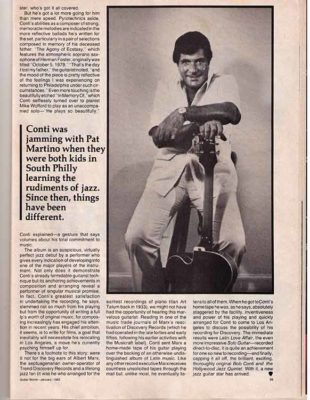
But he’s got a lot more going for him than mere speed. Pyrotechnics aside, Conti ‘s abilities as a composer of strong, memorable melodies are indicated in the more reflective ballads he’s written for the set, particularly in a pair of selections composed in memory of his deceased father. “The Agony of Ecstasy,” which features the atmospheric soprano saxophone of Herman Riley, originally was titled “October 5, 1979.” “That’s the day I lost my father,” the guitarist noted, “and the mood of the piece is very reflective of the feelings I was experiencing, on returning to Philadelphia under such circumstances.” Even more touching is the beautifully etched ”In Memory Of” which Conti selflessly turned over to pianist Mike Wofford to play as an unaccompanied solo - ”He plays so beautifully,” Conti explained - a gesture that says volumes about his total commitment to music.
The album is an auspicious, virtually perfect jazz debut by a performer who gives every indication of developing into one of the major players of the instrument. Not only does it demonstrate Conti’s already formidable guitarist technique but its anchoring achievements in composition and arranging reveal a performer of singular musical promise. In fact, Conti ‘s greatest satisfaction in undertaking the recording, he says, stemmed not so much from his playing but from the opportunity of writing a full LP’s worth of original music, for composing increasingly has engaged his attention in recent years.
There’s a footnote to this story: were it not for the big ears of Albert Marx, the septuagenarian owner-operator of Trend/Discovery Records and a lifelong jazz fan, we might not have had the opportunity of hearing this marvelous guitarist. Reading in one of the music trade journals of Marx’s reactivation of Discovery Records (which he had operated in the late forties and early fifties, following his earlier activities with the Musicraft label), Conti sent Marx a tape of his guitar playing over the backing of an otherwise undistinguished album of Latin music. Like any other record executive Marx receives countless unsolicited tapes through the mail, but unlike most, he eventually listens to all of them. When he got to Conti’s tape, he was, as he says, absolutely staggered by the facility, inventiveness and power of his playing and quickly arranged for Conti to come to Los Angeles to discuss the possibility of his recording for Discovery. The immediate results were Latin Love Affair, the even more impressive Solo Guitar - recorded Direct-To-Disc, quite an achievement for one so new to recording-and finally, capping it all off, the brilliant, exciting, thoroughly original Robert Conti and the Jazz Quintet. With it, a new jazz guitar star has arrived.
"I am having the most fun practicing that I have ever had. Mr. Conti's comprehension of what we, as much lesser players, need for tools to learn, is a tremendous testament to his genius as not only a player of unparalleled brilliance but also as a teacher on the same level of his incredible playing. For years (I haven't practiced in almost 10 years) I played scales and arpeggios until I could play them at very fast tempos. But when I tried to jam with real jazz players, I had no library of lines to rely on so my solos were just sterile scales which frustrated me to no end. I was not playing music. Just playing rote gymnastics.
I can't thank Mr. Conti enough. He has finally shown me that there is a way to learn jazz. BY PLAYING IT! I apologize for being so long winded about this. It's just that I am so excited that I know in a while from now I believe I will finally be able to play music. Play jazz. Thanks (again!)"
Robert Austin
Westerly, RI